History of Satpura Tiger Reserve
The Satpura Tiger Reserve is more than just forest and wildlife. With a rich and fascinating past, it is a land remembered. Satpura, situated in Madhya Pradesh, is one of the most incredible and tranquil tiger reserves in India. Its history stretches back millennia, long before it was a protected forest.
Satpura’s history is a tale of nature and prehistoric peoples, a land guided by tribal tradition and European interpretation, finally shaped by contemporary conservation ideology. Over the years this forest was transformed from a wilderness to one of the premier wildlife reserves in India. A brief history of Satpura Tiger Reserve and why it is so wildlife rich today.
This blog is a walk through in the journey of Satpura, from age- old to current.
Ancient History of the Satpura Region
“Satpura” is a Sanskrit word which means “seven mountains”. The Satpura range is also among the oldest mountain ranges in India. These hills and forests and valleys have been here lying for millions of years, feeding life even before recorded history.
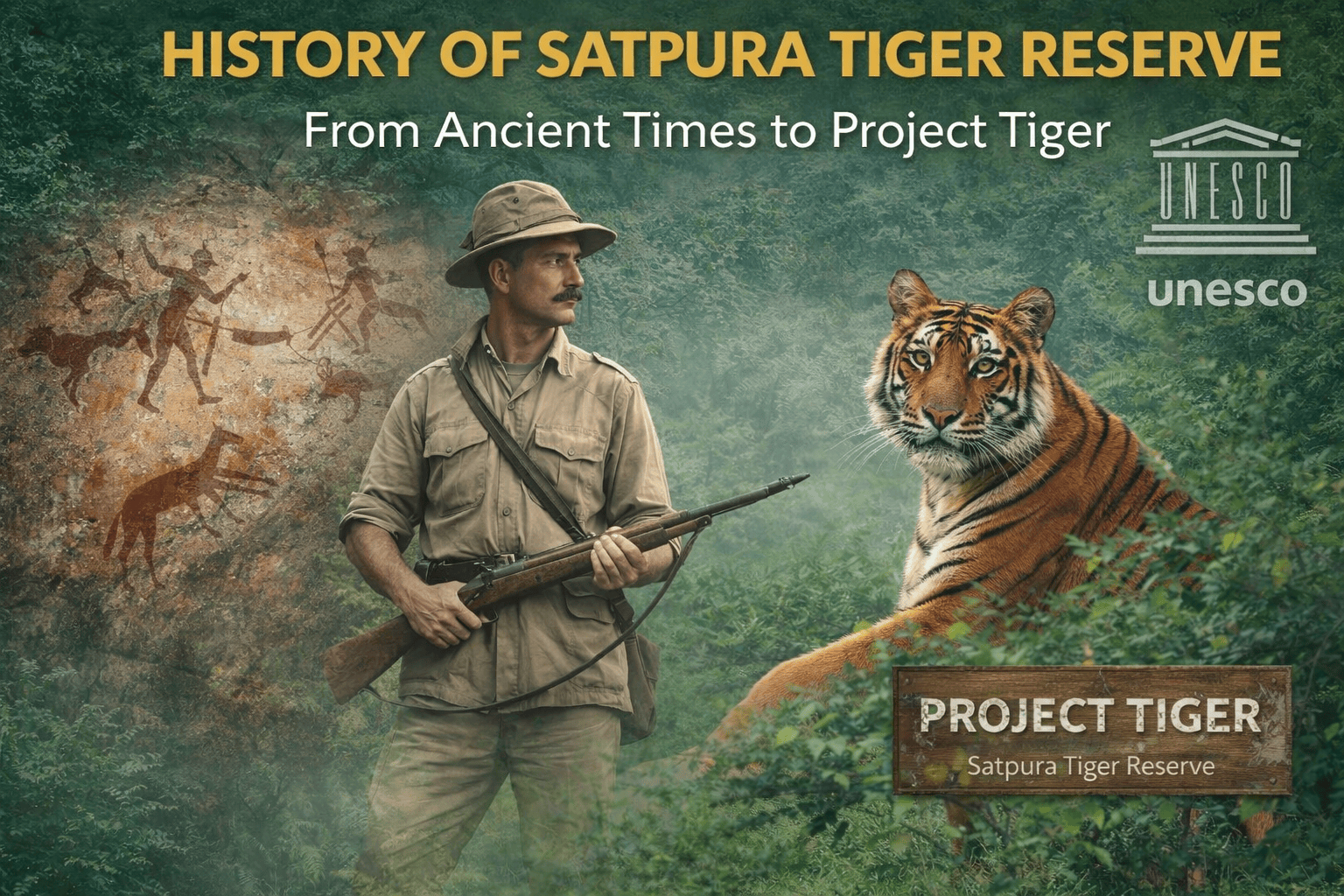
The Satpura hills were home to early man, as is evident from relics of primitive man discovered by the Archaeological Survey of India. Ancient paintings and tools can be found in the rock shelters and caves within and near the forest. They include paintings of animals, hunting scenes, and what our ancestors did for a living. This is a clear indication that humans relied on forests to meet their basic needs for food, clothing, and shelter.
Long before villages dotted the landscape, tribal people lived in the forests of Satpura. The forest was their home, and they lived in harmony with nature, and sustainably with its resources. The human-forest nexus in the Satpura is ancient and profound.
Indigenous Tribes and Their Connection with the Forest
For centuries, tribal groups such as the Gond, Korku, and Bharia resided in and around the Satpura forests. These tribes were well-versed with the forest, animals, seasons and plants.
They relied on the forest for sustenance, medicines and housing. They worshiped nature and regarded forest and animals as holy. Hunting was a necessity-based activity and traditional rules of hunting protected forests.
Even today, tribal knowledge is central to conservation. Many locals are now employed as forest guards and trackers and guides. Their knowledge of animal movement and forest sign, allows them to get the best wildlife experience.
Discovery of Satpura During British Rule
Modern history of Satpura Tiger Reserve started during the British period in the Indian subcontinent. Around the middle of the 19th century, the Satpura area was explored by a British officer, Captain James Forsyth.
Captain Forsyth was fascinated with the forest, the wildlife and the scenery. On Satpura His famous “highland book”, “The Highlands of Central India”, was published in 1871. His writings made Satpura a ‘special place of nature’ and his artistic talent captured iconic images of the landscape.
Forsyth was of the opinion that forests of Satpura ought to be preserved. His concepts contributed to the early development of forest management and conservation in the area.
Bori Reserve: India’s Oldest Forest Reserve
Among the key turning points in the History of Satpura Tiger Reserve was the establishment of Bori Reserve Forest.
The British government had already notified Bori as a reserve forest in 1865. This ranks it among the oldest sanctuaries of forested areas in India. Subsequently in 1931, it was declared as wildlife sanctuary in an official manner.
Bori was primarily reserved for the conservation of timber and forest wealth. But it was this early protection that also conserved wildlife and wild lands. When the forests were burnt elsewhere, countless species had survived here.
At present Bori Wildlife Sanctuary is at the heart of Satpura Tiger Reserve and forms the entirety of its zonal core.
Pachmarhi: A Hill Station with Conservation Value
Pachmarhi, a charming hill station close to Satpura, also holds a significant place in history. The British developed Pachmarhi as a summer resort in view of its cool climate.
Gradually the forests in the Pachmarhi region began to be valued for their environmental benefits. In 1977, the Pachmarhi Wildlife Sanctuary was established.
This sanctuary was to play a pivotal role in the later, larger Satpura plan. The combination of forest, waterfalls and animals brought ecological significance to Pachmarhi.
Formation of Satpura National Park
In 1981, the Satpura National Park was constituted by amalgamating forest tracts in the Bori and Pachmarhi highlands. This was a giant leap for the conservation of wildlife in central India.
In contrast to many other national parks, Satpura was designed to be about biodiversity, not simply tigers. The park was a sanctuary for forests, rivers, grasslands and hills.
This measure brought regional advancement in forest-and-wildlife protection.
Pachmarhi Biosphere Reserve
In 1999, the government declared the Pachmarhi Biosphere Reserve, which included:
- Satpura National Park
- Bori Wildlife Sanctuary
- Pachmarhi Wildlife Sanctuary
This was a biosphere reserve established for the protection of wildlife and human life. It is the first biosphere reserve in Madhya Pradesh.
The biosphere concept found space to evolve with human activity being regulated in buffer zones, and the core forest areas kept intact. It was a win for both the local people and the local environment.
Declaration of Satpura Tiger Reserve
In 2000, Satpura was formally notified as a Tiger Reserve under India’s Project Tiger scheme. It provided Satpura with more stringent legal protection, better funding and scientific monitoring of wildlife. Priority was given to tiger conservation, but the reserve remained a refuge for all wildlife forms. Unlike most of the tiger reserves, Satpura reserve promoted the low tourism pressures and natural behaviour of animals. This aided reclusive and uncommon species survive.
Modern Conservation and Recognition
In recent years, Satpura Tiger Reserve has received national and international recognition. In 2021, it was included in the tentative list of UNESCO World Heritage Sites along with other central Indian forests.
Satpura has also won awards for:
- Eco-friendly tourism
- Visitor management
- Biodiversity conservation
Several villages were relocated from core areas with proper support. This helped create safe spaces for wildlife and reduced human-animal conflict.
Modern tools like camera traps, GPS tracking, and scientific surveys are used to monitor animals today.
Historical Buildings and Forest Landmarks
Satpura Tiger Reserve is also home to several historical monuments. The colonial bungalows, old forest rest houses, and trails are still found within the forest.
The legendary Bison Lodge at Pachmarhi is a British-period construction. The primeval tracks used in old days by tribes and forest officers do penetrate into the jungle.
These monuments take one back in time and give a glimpse to Satpura’s journey through ages.
How History Shapes Satpura Today
Satpura National Park today, with all its wildlife richness, owes its existence to this long tradition of protection. Early forest reserves reclaimed trees. Tribal traditions honored nature. British ideas of conservation established protected areas. Modern protections were bolstered.
Now Satpura is home to tigers, leopards, bears, wild dogs, rare cats, birds and reptiles. Its serene pace and few tourists enable the animals to act as nature intended.
Satpura’s story is that conservation is most effective, when people and nature are respected in tandem.
Conclusion: A Living History of Nature and Conservation
The Satpura Tiger Reserve has a past of nature, people and protection. From cave-inhabiting tribes of prehistory to British adventurers and present-day conservationists, Satpura has witnessed many transitions.
Now it is one of the best run in the country for the conservation for wildlife in India. Conserving Satpura is therefore not just about saving animals and forests, but also a vibrant natural history that owes a debt of gratitude to future generations.